


The Love That Wasn’t: Growing Up With a Narcissistic Parent

There is a particular kind of loneliness that does not have a name yet. It is the loneliness of a child who was never alone, but was never truly seen. The parent was there, technically. The meals were made. The clothes were washed. Maybe there were even birthday cakes and Christmas mornings and the occasional “I love you” said out loud in front of people. But underneath all of that, the child knew something was off in the way only children know things: in the body, before the words arrive.
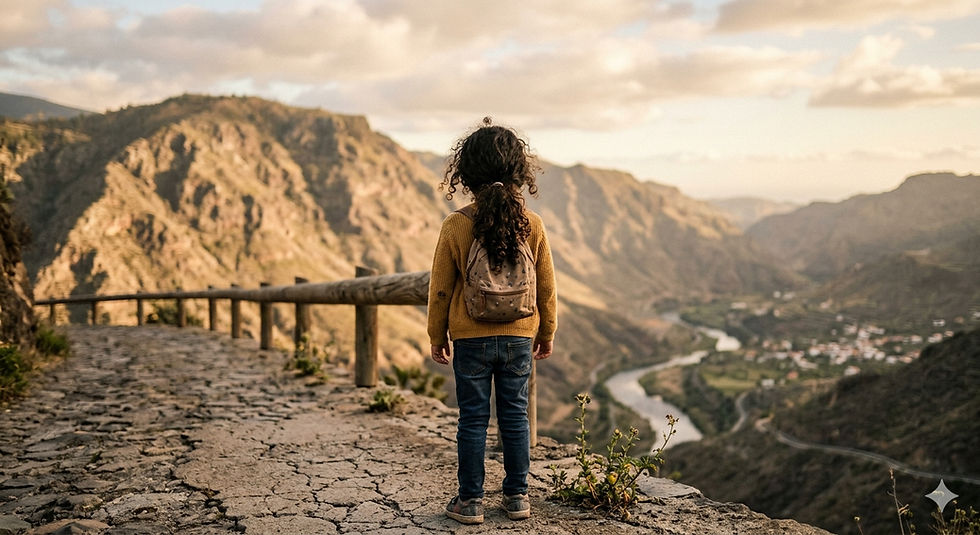
That child may be reading this right now. As an adult. Still waiting, on some level, for the love to finally feel real.
This one is for you.
I want to start here, before we get anywhere near research or clinical language or diagnostic categories, because the most important thing I need you to hear is not about narcissism. It is about you. You were not broken. You were not too sensitive. You were not asking for too much. You were a child trying to attach to a parent whose wound was so old, so deep, so unexamined, that they had no self left over to give to you. They gave you the performance of love. And you, being a child and therefore wise in the way of pure survival, learned to receive it and call it love, because the alternative was unbearable.
But here is what I have come to understand, after years of sitting across from people who grew up exactly this way: the body always knows the difference.
The wound has a name, but the name is not the whole story.
In clinical circles, we call it narcissistic personality disorder, or NPD. And I will be honest with you the way I am always honest with my people: the research on whether a toxic narcissist can genuinely love their children is not encouraging. We are not talking about someone who loves imperfectly, which is every single one of us. We are talking about a specific configuration of wounding that makes empathy, that makes true attunement, structurally impossible without profound intervention and usually years of work that most people with this wound never seek.
The research tells us that narcissistic parents tend to see their children not as separate human beings with inner worlds, but as extensions of themselves. Possessions. Reflections. The child is loved when they make the parent look good and discarded, subtly or overtly, when they do not. Affection becomes a currency, distributed based on performance. Independence, which is the biological destiny of every child, becomes a threat.
And so the child learns to get smaller.
But I need us to hold two truths at once, because that is where the healing actually lives.

Truth one: this is real. The harm is real. The research is clear. A parent who cannot access empathy cannot love in the way a child needs to be loved, and no amount of effort or patience or perfect behavior on the child’s part will change that equation.
Truth two: the person doing this harm is themselves a child who was not loved right. Most of what we pathologize in adult behavior, including what we call narcissism, is the sophisticated architecture of survival. Somewhere, long before the diagnosis, there was a little person who learned that their authentic self was not safe. Not welcome. Not enough. And so they built a self that could not be hurt because it could not be reached. They built walls and called them a personality. They learned to control because vulnerability had only ever led to pain.
This does not excuse the harm. But it does explain the inheritance.

Because here is what nobody in mainstream psychology talks about enough: narcissism is a generational wound. It does not begin with the person in front of you. It began somewhere back in the lineage, in some moment of rupture, some experience of abandonment or abuse or profound neglect, that was never named, never healed, never grieved. It got passed down the way all unhealed things get passed down, not through genes alone but through the nervous system, through the quality of attunement in those first years of life, through what was modeled and what was silenced.
In many indigenous frameworks, we understand that we do not just carry our own wounds. We carry our ancestors’ wounds until someone in the line does the work of healing and stops the transmission. The narcissistic parent is, in this sense, a messenger, however painful. They are showing you exactly what happens when a wound goes unnamed across generations.
What the child learns, and what it costs.
In families with narcissistic parents, children are often assigned roles without ever having a say. There is frequently the Golden Child, the one who reflects the parent’s best image back to them, who is praised and elevated and quietly imprisoned by the pressure of constant performance. And there is the Scapegoat, the one who carries the family’s shadow, who is blamed and minimized and sometimes, paradoxically, the one who eventually gets free first, because they never had the illusion of approval to lose.
Both roles cost something profound.
The Golden Child learns that they are loved for what they produce, not for who they are. The Scapegoat learns that they are fundamentally flawed, that their presence is a problem. Neither child learns that they are simply enough. That they do not have to earn love. That love is not a transaction.

And because we teach what we live, these children grow into adults who often find themselves in relationships that feel strangely familiar. Relationships where they give more than they receive. Where they contort themselves trying to be enough. Where love feels conditional, unpredictable, like something they might lose at any moment if they stop performing correctly.
This is not a character flaw. This is a wound that learned to call itself normal.
The grief nobody tells you to have.
Here is the hardest part, and I am going to say it plainly because I believe you can hold it: you may need to grieve a parent who is still alive.
This is one of the most disorienting griefs there is. Because there is no funeral. There is no casserole brigade. Nobody sends flowers when you finally accept that the parent standing in front of you is not able to give you what you needed. What you still, on some cellular level, want.

But the grief is real, and it needs somewhere to go.
What you are grieving is not actually the parent they were. You are grieving the parent they could not be. The one you deserved. The one who would have seen you fully, celebrated you without envy, held you without needing something back. That parent existed in your imagination, in your hope, in every moment you tried harder thinking that if you just got it right, the love would finally land differently.
That child’s hope deserves to be honored. And then it deserves to be gently, lovingly released.
A word to the one who might be reading this and recognizing themselves as the parent.
If something in these words has made you look inward rather than outward, I want to speak to you too.
I know how frightening it is to see yourself in a description like this. I know the instinct is to defend, to explain, to find the exceptions. I am not here to indict you. I am here because I believe in the radical possibility of healing at any age, in any generation.
The wound that shaped you was not your fault. What you do with that information now, that is where your power lives.
Your children, whether they are still children or are grown, do not need you to be perfect. They need you to be honest. They need you to stop performing and start feeling, even if feeling is terrifying. They need you to get support, real support, not so you can become the parent you wished you had been, but so that the transmission stops here. So that what gets passed to the next generation is not the wound, but the work.
That is the most profound act of love available to you.
How healing actually happens.
Healing from this kind of wound is not linear and it is not fast, and anyone who tells you otherwise is selling something. What I can tell you is that it is possible. I have watched it happen. I have watched people who grew up with a fundamental belief that they were unlovable discover, sometimes late in life, that they are not only lovable but deeply, specifically, irreplaceably worthy.
It begins with naming. Calling the thing what it was.
It deepens with grief. Letting yourself feel what you spent years not feeling.
It expands with community. Finding people who can offer you the consistent, non-transactional love that recalibrates your nervous system’s understanding of what love actually is.
And it anchors in the body. Because the wound lives in the body, and that is where the healing has to eventually reach.
You did not come from a broken lineage. You came from a lineage that is waiting to be healed. And in that reading, you are not just healing for yourself.
You are healing for everyone who came before you and everyone who comes after.
That is not a small thing.
That is medicine.
Rest in that.
If something here touched you, share it with someone who might need a soft place to land today. And if you are in that place yourself, know that we have room for you here.


Comments